|
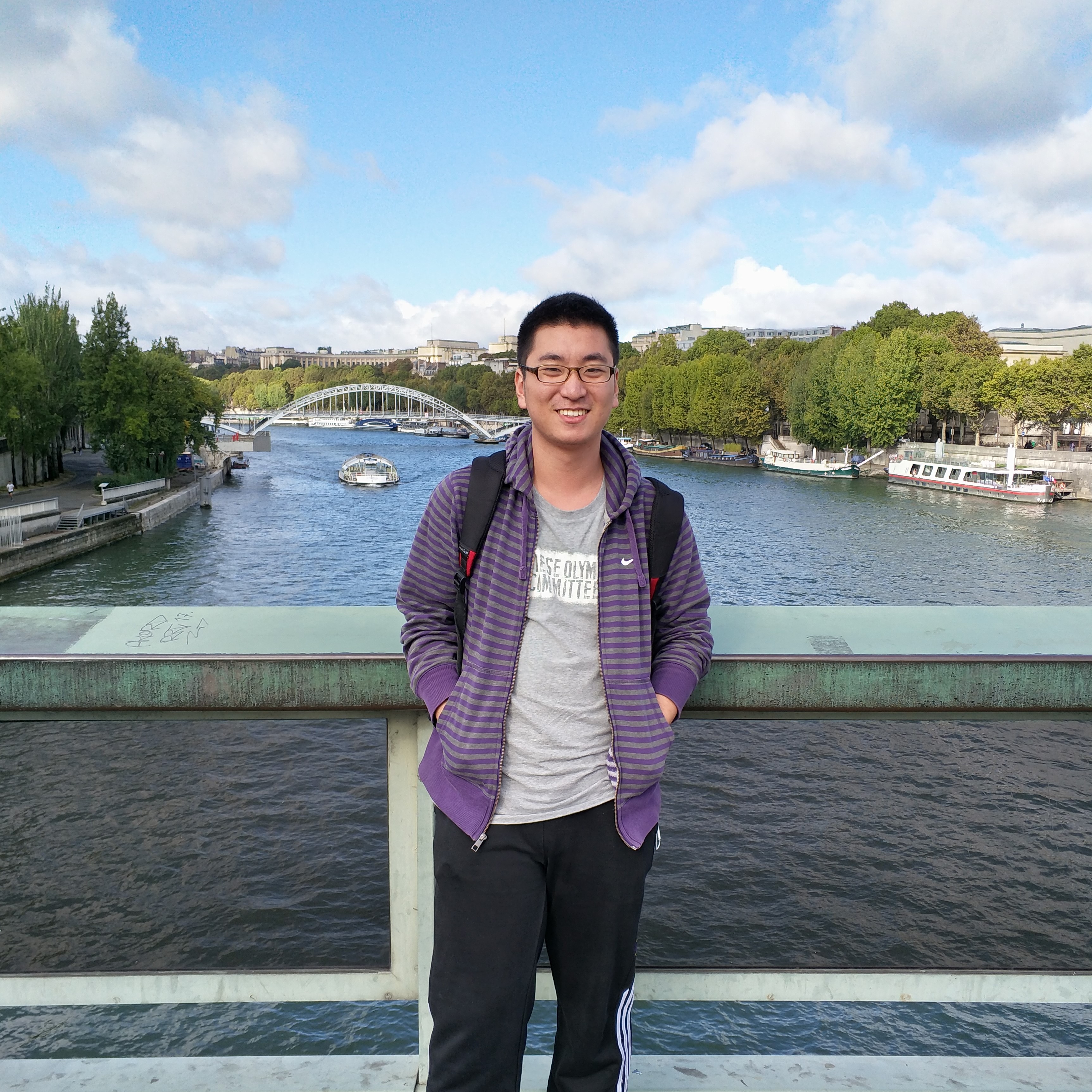
Yihong Chen I am a Ph.D. student at EPFL CVLAB. I obtained my Master's degree in Data Science from Peking University, where I was fortunate to be advised by Prof. Liwei Wang. I also spent some wonderful time as a research intern of Visual Computing Group in Microsoft Research Asia, working with Dr. Han Hu and Yue Cao, Zheng Zhang. Prior to that, I received my B.S. degree in Mathematics from Xiamen University. My research interests are computer vision, computer graphics and machine learning, especially 3D computer vision, scene understanding and perception tasks. Email / CV / Google Scholar / Github |
|
News
|
Publication |
|
VecHeart: Holistic Four-Chamber Cardiac Anatomy Modeling via Hybrid VecSets
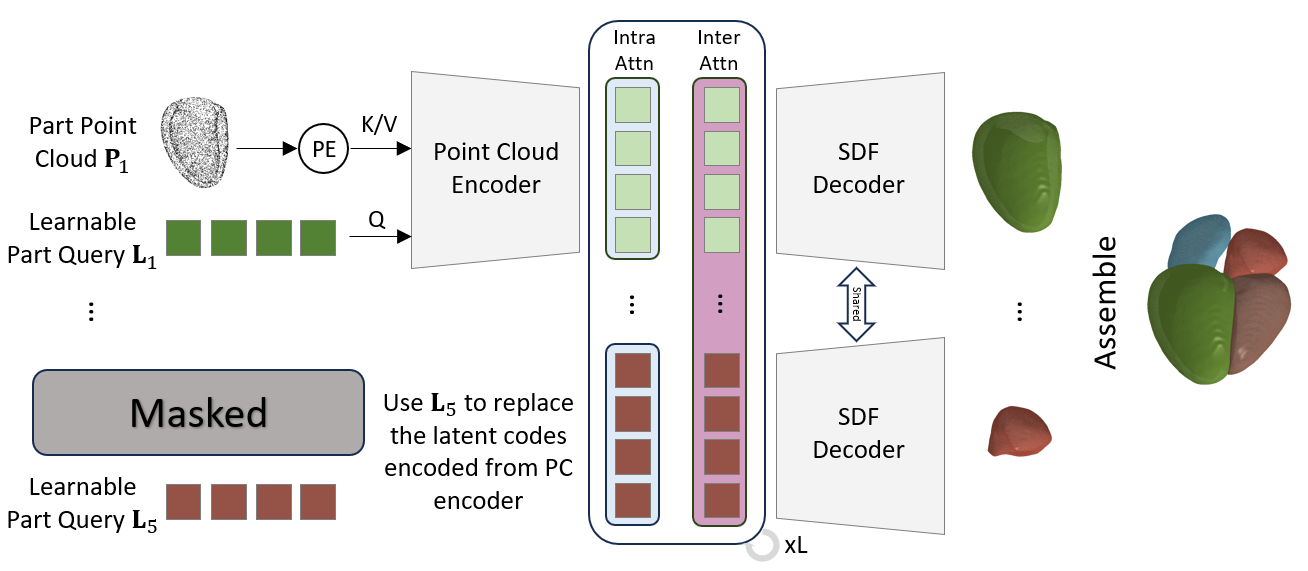
Yihong Chen, Pascal Fua Medical Image Computing and Computer Assisted Intervention (MICCAI), 2026 [] [code] Accurate cardiac anatomy modeling requires the model to be able to handle intricate interrelations among structures. In this paper, we propose VecHeart, a unified framework for holistic reconstruction and generation of four-chamber cardiac structures. To overcome the limitations of current feed-forward implicit methods, specifically their restriction to single-object modeling and their neglect of inter-part correlations, we introduce Hybrid Part Transformer, which leverages part-specific learnable queries and interleaved attention to capture complex inter-chamber dependencies. Furthermore, we propose Anatomical Completion Masking and Modality Alignment strategies, enabling the model to infer complete four-chamber structures from partial, sparse, or noisy observations, even when certain anatomical parts are entirely missing. VecHeart also seamlessly extends to 3D+t dynamic mesh sequence generation, demonstrating exceptional versatility. Experiments show that our method achieves state-of-the-art performance, maintaining high-fidelity reconstruction across diverse challenging scenarios. |
|
End-to-End 4D Heart Mesh Recovery Across Full-Stack and Sparse Cardiac MRI
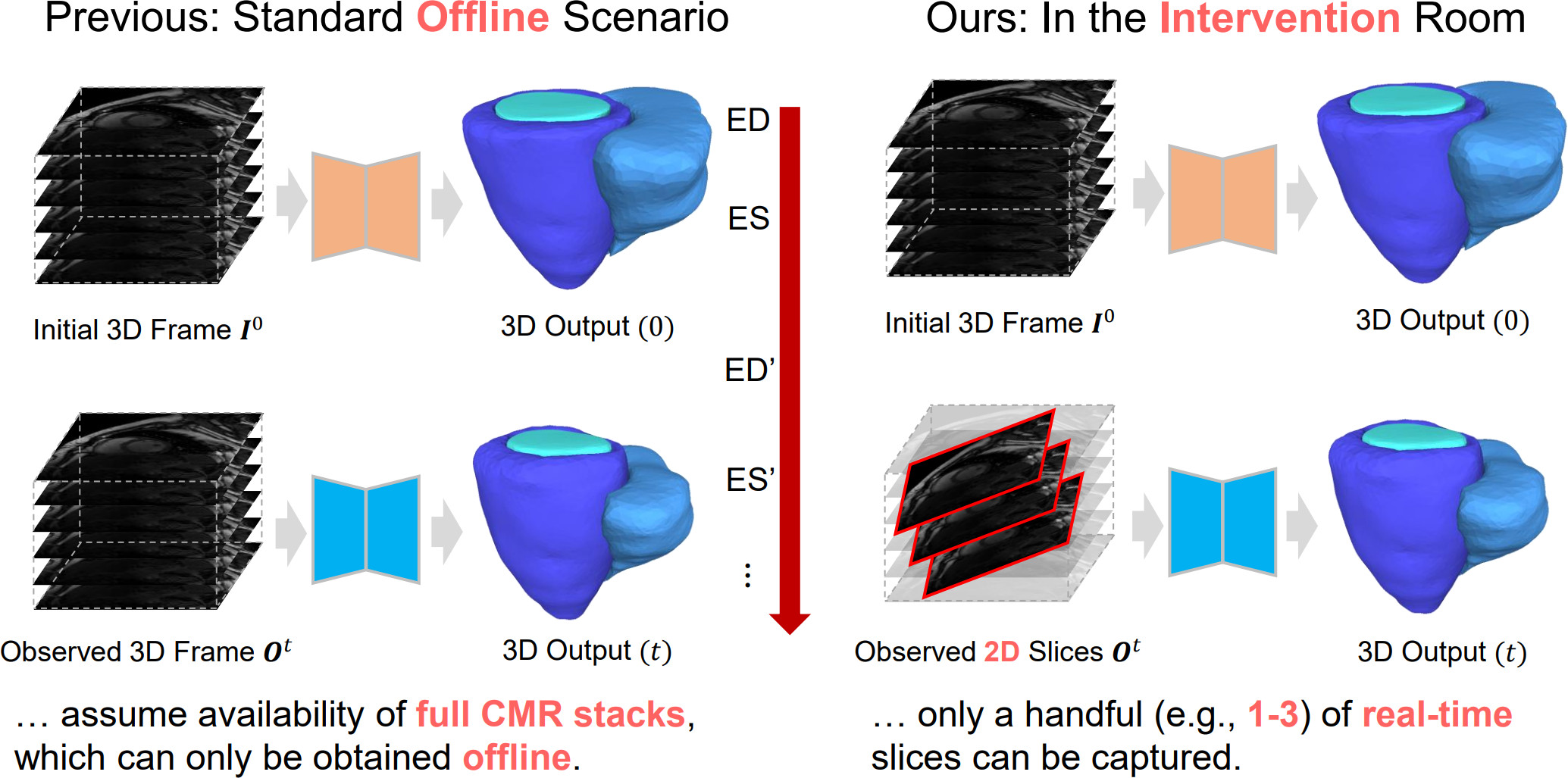
Yihong Chen, Jiancheng Yang, Deniz Sayin Mercadier, Hieu Le, Juerg Schwitter, Pascal Fua Transactions on Machine Learning Research (TMLR), 2026 [] [code] Reconstructing cardiac motion from CMR sequences is critical for diagnosis, prognosis, and intervention. Existing methods rely on complete CMR stacks to infer full heart motion, limiting their applicability during intervention when only sparse observations are available. We present TetHeart, the first end-to-end framework for unified 4D heart mesh recovery from both offline full-stack and intra-procedural sparse-slice observations. Our method leverages deformable tetrahedra to capture shape and motion in a coherent space shared across cardiac structures. Before a procedure, it initializes detailed, patient-specific heart meshes from high-quality full stacks, which can then be updated using whatever slices can be obtained in real-time, down to a single one during the procedure. TetHeart incorporates several key innovations: (i) an attentive slice-adaptive 2D-3D feature assembly mechanism that integrates information from arbitrary numbers of slices at any position; (ii) a distillation strategy to ensure accurate reconstruction under extreme sparsity; and (iii) a weakly supervised motion learning scheme requiring annotations only at keyframes, such as the end-diastolic and end-systolic phases. Trained and validated on three large public datasets and evaluated zero-shot on additional private interventional and public datasets without retraining, TetHeart achieves state-of-the-art accuracy and strong generalization in both pre- and intra-procedural settings. |
|
PointScatter: Point Set Representation for Tubular Structure Extraction
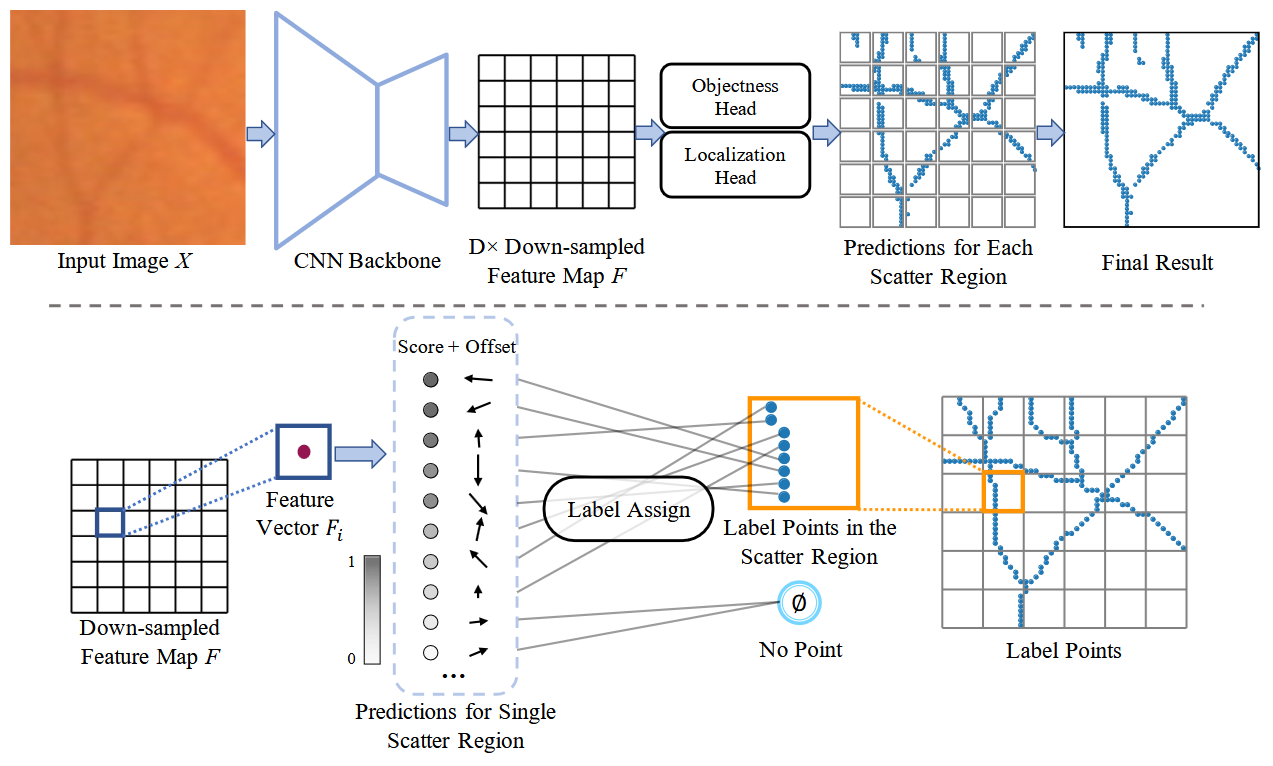
Dong Wang, Zhao Zhang, Ziwei Zhao, Yuhang Liu, Yihong Chen, Liwei Wang Europe Conference on Computer Vision (ECCV), 2022 [] [code] This paper explores the point set representation for tubular structure extraction tasks. Compared with the traditional mask representation, the point set representation enjoys its flexibility and representation ability, which would not be restricted by the fixed grid as the mask. Inspired by this, we propose PointScatter, an alternative to the segmentation models for the tubular structure extraction task. PointScatter splits the image into scatter regions and parallelly predicts points for each scatter region. We further propose the greedy-based region-wise bipartite matching algorithm to train the network end-to-end and efficiently. We benchmark the PointScatter on four public tubular datasets, and the extensive experiments on tubular structure segmentation and centerline extraction task demonstrate the effectiveness of our approach. |
|
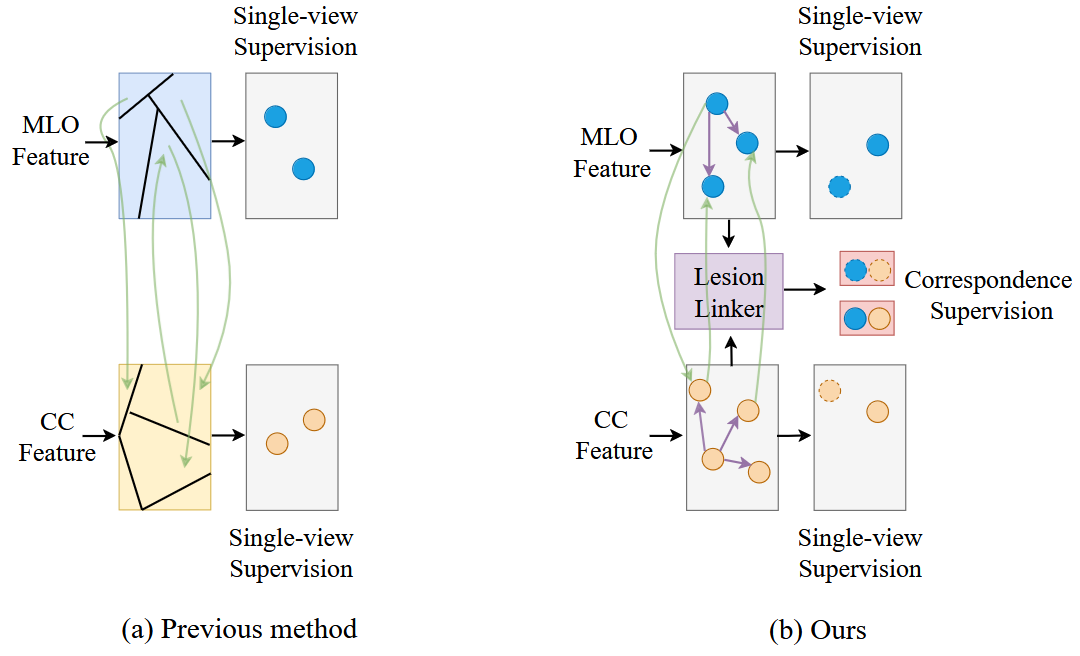
Check and Link: Pairwise Lesion Correspondence Guides Mammogram Mass Detection
Ziwei Zhao, Dong Wang, Yihong Chen, Ziteng Wang, Liwei Wang Europe Conference on Computer Vision (ECCV), 2022 [] Detecting mass in mammogram is significant due to the high occurrence and mortality of breast cancer. In mammogram mass detection, modeling pairwise lesion correspondence explicitly is particularly important. However, most of the existing methods build relatively coarse correspondence and have not utilized correspondence supervision. In this paper, we propose a new transformer-based framework CL-Net to learn lesion detection and pairwise correspondence in an end-to-end manner. In CL-Net, View-Interactive Lesion Detector is proposed to achieve dynamic interaction across candidates of cross views, while Lesion Linker employs the correspondence supervision to guide the interaction process more accurately. The combination of these two designs accomplishes precise understanding of pairwise lesion correspondence for mammograms. Experiments show that CL-Net yields state-of-the-art performance on the public DDSM dataset and our in-house dataset. Moreover, it outperforms previous methods by a large margin in low FPI regime. |
|
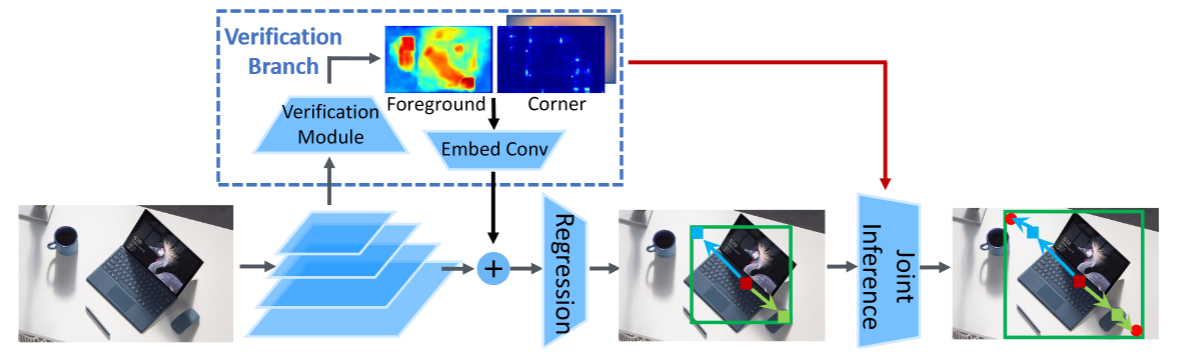
RepPoints V2: Verification Meets Regression for Object Detection
Yihong Chen, Zheng Zhang, Yue Cao, Liwei Wang, Stephen Lin, Han Hu Neural Information Processing Systems (NeurIPS), 2020 [] [code] Verification and regression are two general methodologies for prediction in neural networks. Each has its own strengths: verification can be easier to infer accurately, and regression is more efficient and applicable to continuous target variables. Hence, it is often beneficial to carefully combine them to take advantage of their benefits. In this paper, we take this philosophy to improve state-of-the-art object detection, specifically by RepPoints. Though RepPoints provides high performance, we find that its heavy reliance on regression for object localization leaves room for improvement. We introduce verification tasks into the localization prediction of RepPoints, producing RepPoints v2, which provides consistent improvements of about 2.0 mAP over the original RepPoints on the COCO object detection benchmark using different backbones and training methods. RepPoints v2 also achieves 52.1 mAP on COCO test-dev by a single model. Moreover, we show that the proposed approach can more generally elevate other object detection frameworks as well as applications such as instance segmentation. |
|
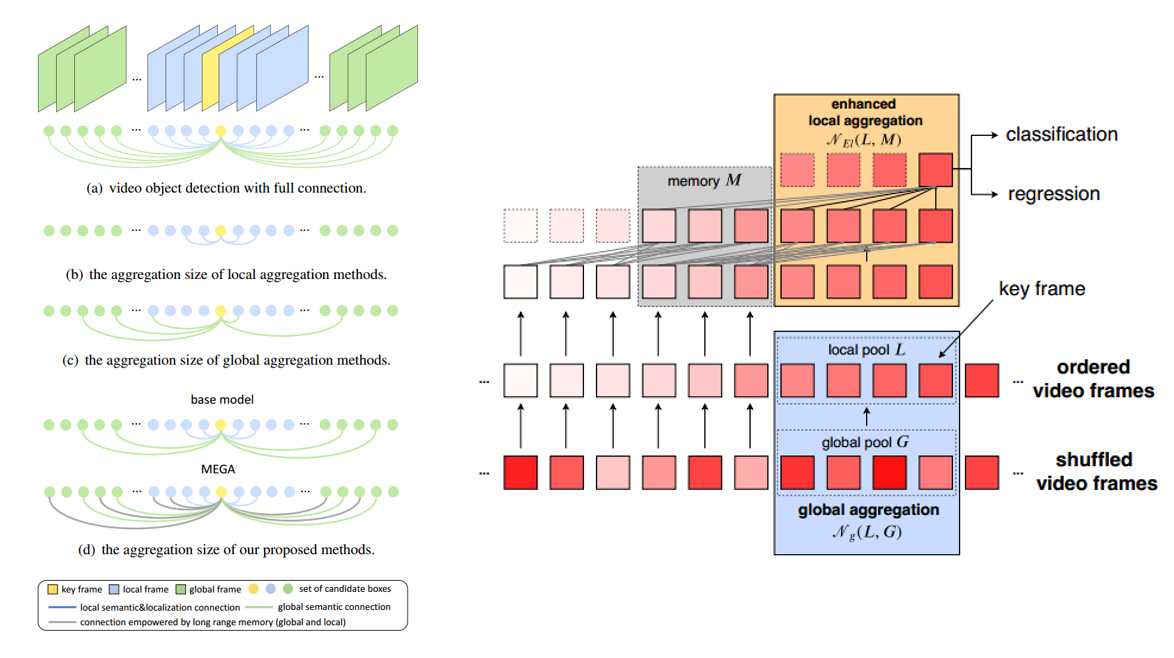
Memory Enhanced Global-Local Aggregation for Video Object Detection
Yihong Chen, Yue Cao, Han Hu, Liwei Wang IEEE Conference on Computer Vision and Pattern Recognition (CVPR), 2020 [] [code] How do humans recognize an object in a piece of video? Due to the deteriorated quality of single frame, it may be hard for people to identify an occluded object in this frame by just utilizing information within one image. We argue that there are two important cues for humans to recognize objects in videos: the global semantic information and the local localization information. Recently, plenty of methods adopt the self-attention mechanisms to enhance the features in key frame with either global semantic information or local localization information. In this paper we introduce memory enhanced global-local aggregation (MEGA) network, which is among the first trials that takes full consideration of both global and local information. Furthermore, empowered by a novel and carefully-designed Long Range Memory (LRM) module, our proposed MEGA could enable the key frame to get access to much more content than any previous methods. Enhanced by these two sources of information, our method achieves state-of-the-art performance on ImageNet VID dataset. |
Awards
|
|
Website template stolen from Jon Barron. |